What Really Happens When You Write new Person()?
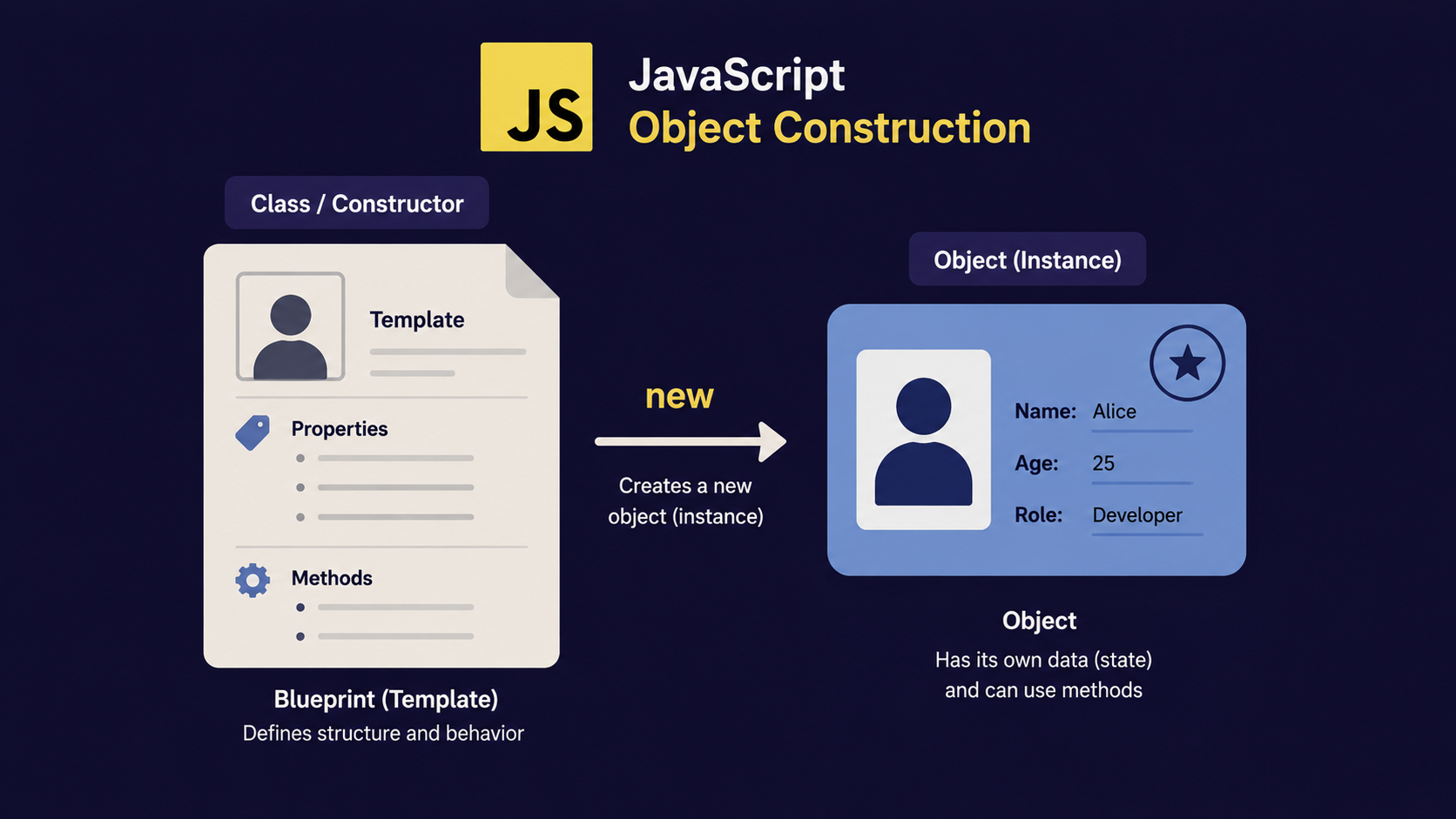
How does new Person() actually build an object?
Many beginners think new is just special syntax that "creates an object," the same way {} does. That's not true.
new is an operator. It takes an ordinary function and runs a four-step process behind the scenes - one of those steps is creating the object, but that's only a quarter of the story.
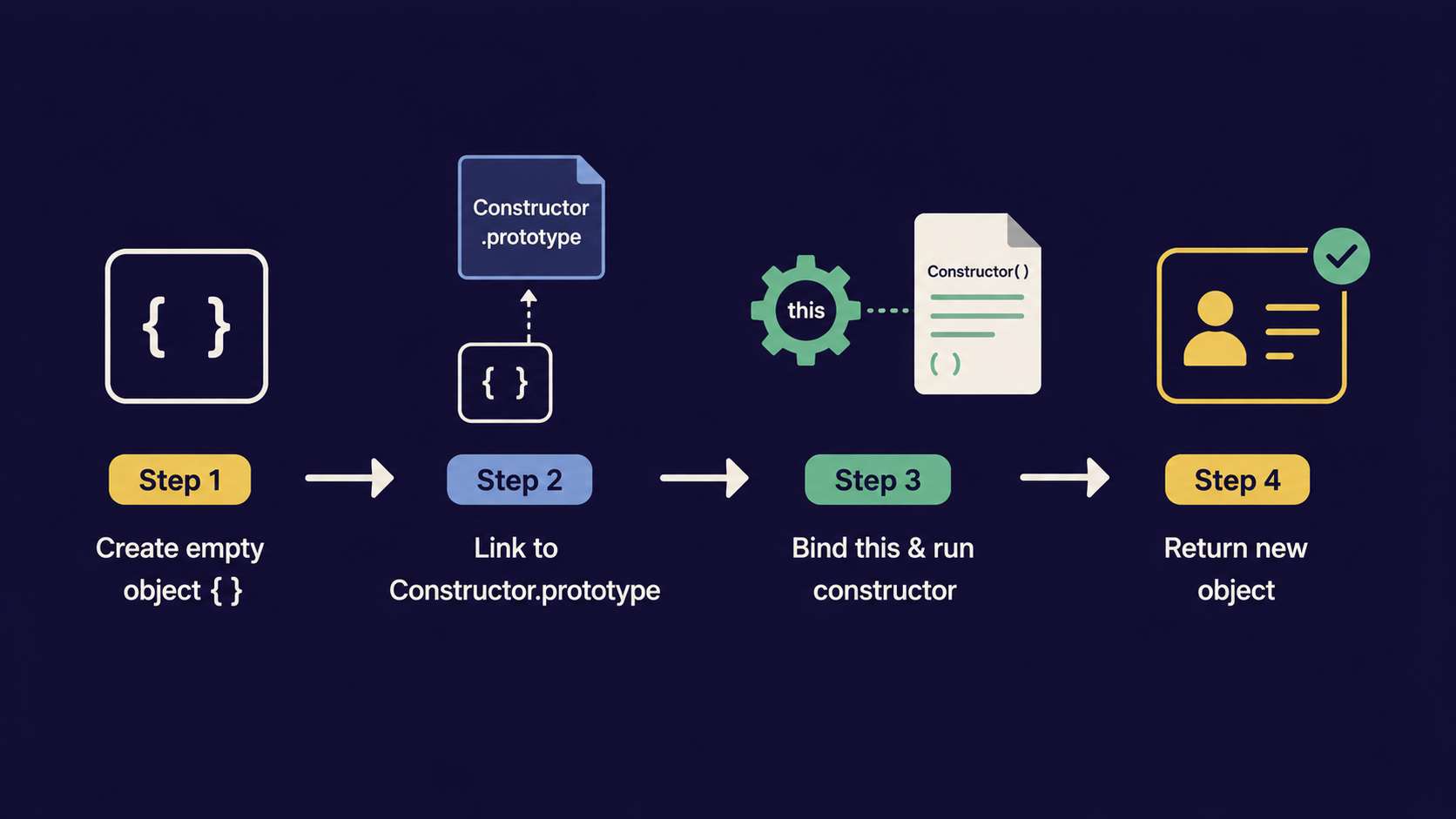
newcreates a fresh object,links it to the constructor's prototype,
runs the constructor with
thispointing at that object, andreturns it.
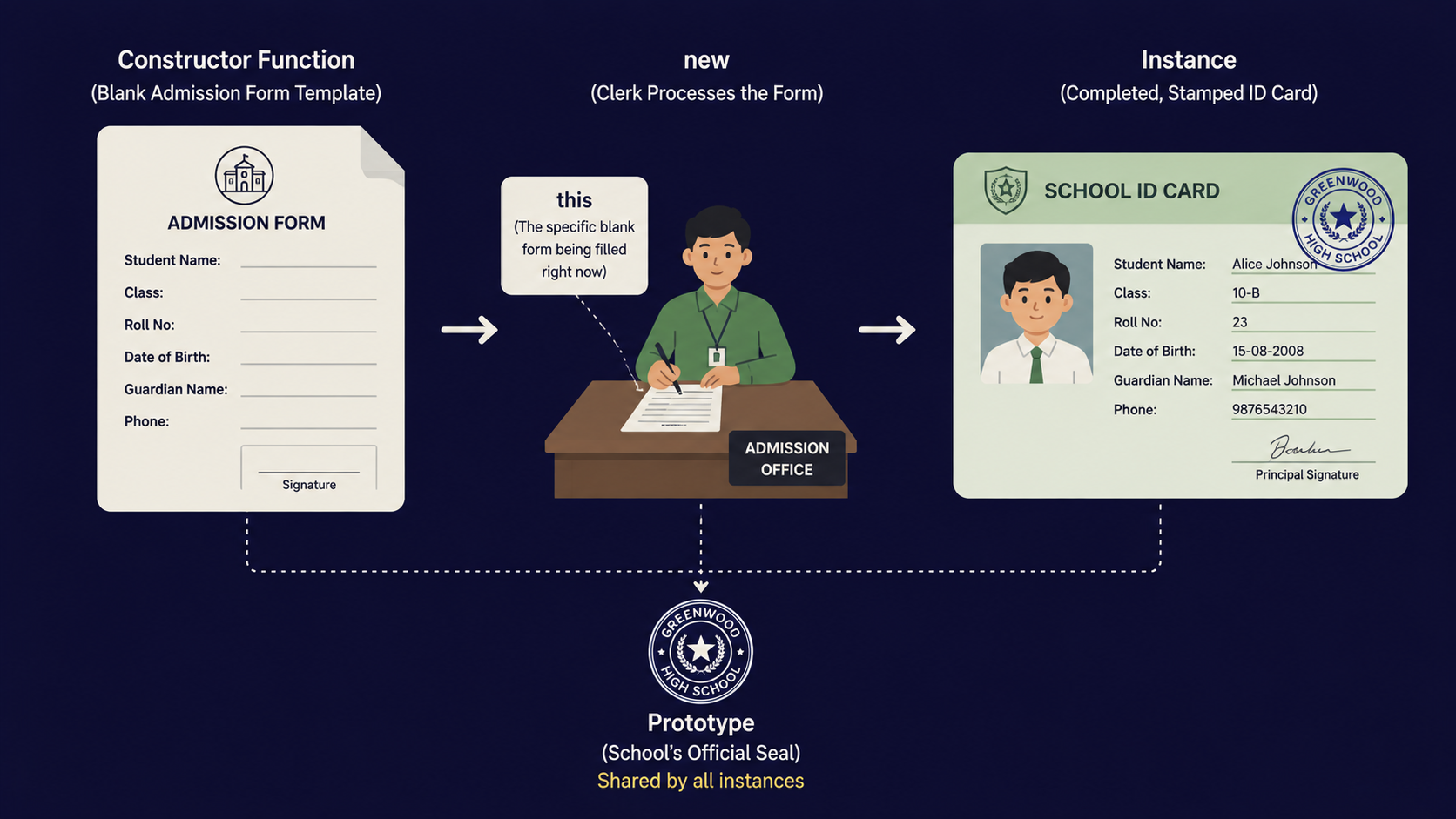
Analogy: The School Admission Office
Think of admission day at a school.
Constructor function = the blank admission form template
newkeyword = the clerk who processes the formthis= the specific blank form being filled right nowPrototype = the school's official seal, kept once in the office
Instance = the completed, stamped ID card handed back to you
Every student gets their own filled-in form. Nobody gets their own personal seal - they all point back to the one seal in the office.
What happens, step by step
When you write new Person("Aisha", 21), JavaScript does this in order:
Creates a new, empty object:
{}Links that object's prototype to
Person.prototypeBinds
thisto the new object and runsPerson's codeReturns the object automatically, unless the constructor explicitly returns a different object
function Person(name, age) {
  this.name = name;
  this.age = age;
}

const aisha = new Person("Aisha", 21);
console.log(aisha.name); // Aisha
Run that in your browser console or a Node.js environment - no setup needed.
Why do we even need new?
Without it, you'd write out a fresh object literal by hand for every single student, copying the same structure over and over.
new automates that repetition. One template, unlimited stamped cards.
Important Rule
Forget the new keyword, and the clerk never shows up. this doesn't get bound to a fresh object - in non-strict mode it silently falls back to the global object.
function Person(name) {
  this.name = name;
}

const broken = Person("Ravi"); // no `new`!
console.log(broken);     // undefined
console.log(window.name); // "Ravi" — leaked onto the global object
This is the single most common constructor - function bug beginners hit. We're skipping Reflect.construct and other advanced - call tricks for now - confidence with the basic flow comes first.
Now that we know how new fills out one form, the next question is: how does that form know which stamp to use?
How does the instance know which methods it can use?
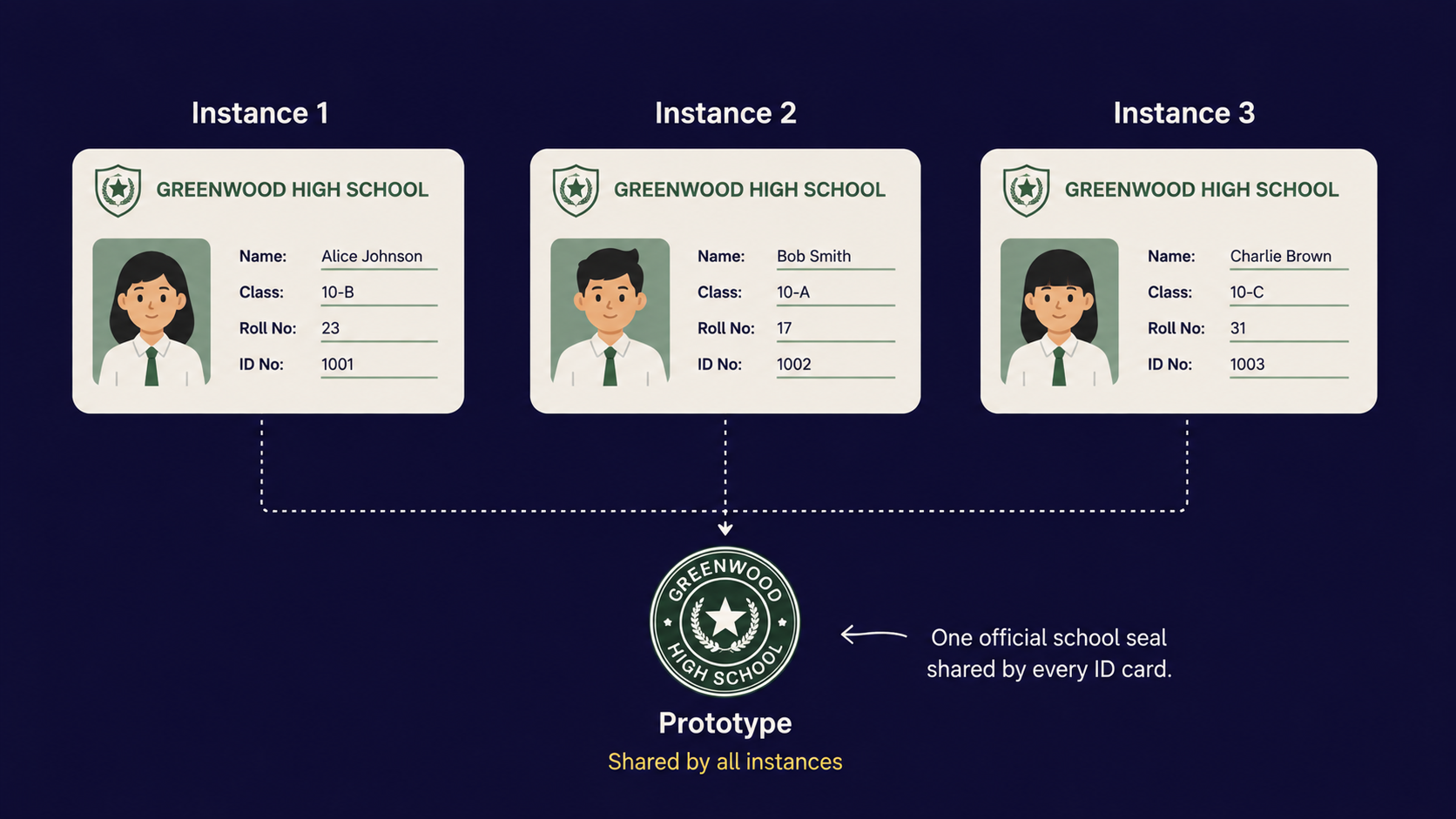
A prototype is a shared object that every instance can reach through a lookup chain, without owning a personal copy.
Going back to the admission office: the seal isn't reprinted onto every card. Each card just points back to the one master seal the office keeps.
Person.prototype.greet = function () {
  return `Hi, I'm ${this.name}`;
};

aisha.greet(); // "Hi, I'm Aisha"
aisha doesn't have greet sitting on itself. JavaScript walks up to Person.prototype, finds it there, and uses it.
| Where the method lives | Memory per instance | Shared across instances? |
|---|---|---|
Defined inside the constructor (this.greet = ...) |
One copy each | No |
| Defined on the prototype | Zero extra copies | Yes |
Note
Put shared behavior on the prototype, not inside the constructor. A thousand students shouldn't carry a thousand copies of the same greet function.
We've covered how objects get created and how they reach shared behavior. Here's the whole flow, start to finish.
Putting it all together
function Car(brand, year) {
  this.brand = brand;
  this.year = year;
}

Car.prototype.honk = function () {
  return `${this.brand} says beep!`;
};

const swift = new Car("Maruti Swift", 2022);
const nexon = new Car("Tata Nexon", 2023);

swift.honk(); // "Maruti Swift says beep!"
swift.honk === nexon.honk; // true — same function, shared via prototype
| Aspect | Calling Car() plainly |
Calling new Car() |
|---|---|---|
| New object created? | No | Yes |
this binding |
Global object (or undefined in strict mode) |
The new object |
| Prototype linked? | No | Yes, to Car.prototype |
| Return value | Whatever the function returns (usually undefined) |
The new object, automatically |
Assignment
Create a constructor function Student with name and grade properties. Add a study method on its prototype. Create two Student instances and confirm they share the same study function reference.
Click to see the solution
function Student(name, grade) {
  this.name = name;
  this.grade = grade;
}

Student.prototype.study = function () {
  return `${this.name} is studying for grade ${this.grade}`;
};

const priya = new Student("Priya", 10);
const arjun = new Student("Arjun", 10);

console.log(priya.study === arjun.study); // true
Both instances point to the exact same study function on Student.prototype - nothing was duplicated.
Conclusion
newruns a four-step process: create, link, bind, returnA constructor function is just a normal function used as a template
Object creation happens automatically inside step one of
newPrototype linking is what lets instances share methods without copying them
Instances are the individual objects
newhands back to you
If this felt like a lot happening behind one keyword, that's okay. What matters is understanding the flow, not memorizing every internal step on day one.
One housekeeping note for readers following the series in order: this article explains the exact mechanism that JavaScript's class syntax quietly runs under the hood. If you read the OOP/Classes post first, it's worth circling back here afterward - class is a template over the new + prototype flow covered above, not a separate concept.
If you find this helpful, drop a comment or reaction.


