How Does Node.js Handle Multiple Requests With Just One Thread?
How Does Node.js Handle Multiple Requests With Just One Thread?
Many beginners assume this: one thread means one request at a time. So a Node.js server should choke the moment a second user shows up.
That's not true. A single Node.js thread routinely serves thousands of concurrent users without breaking a sweat, and the trick behind it is one of the most important ideas in backend development.
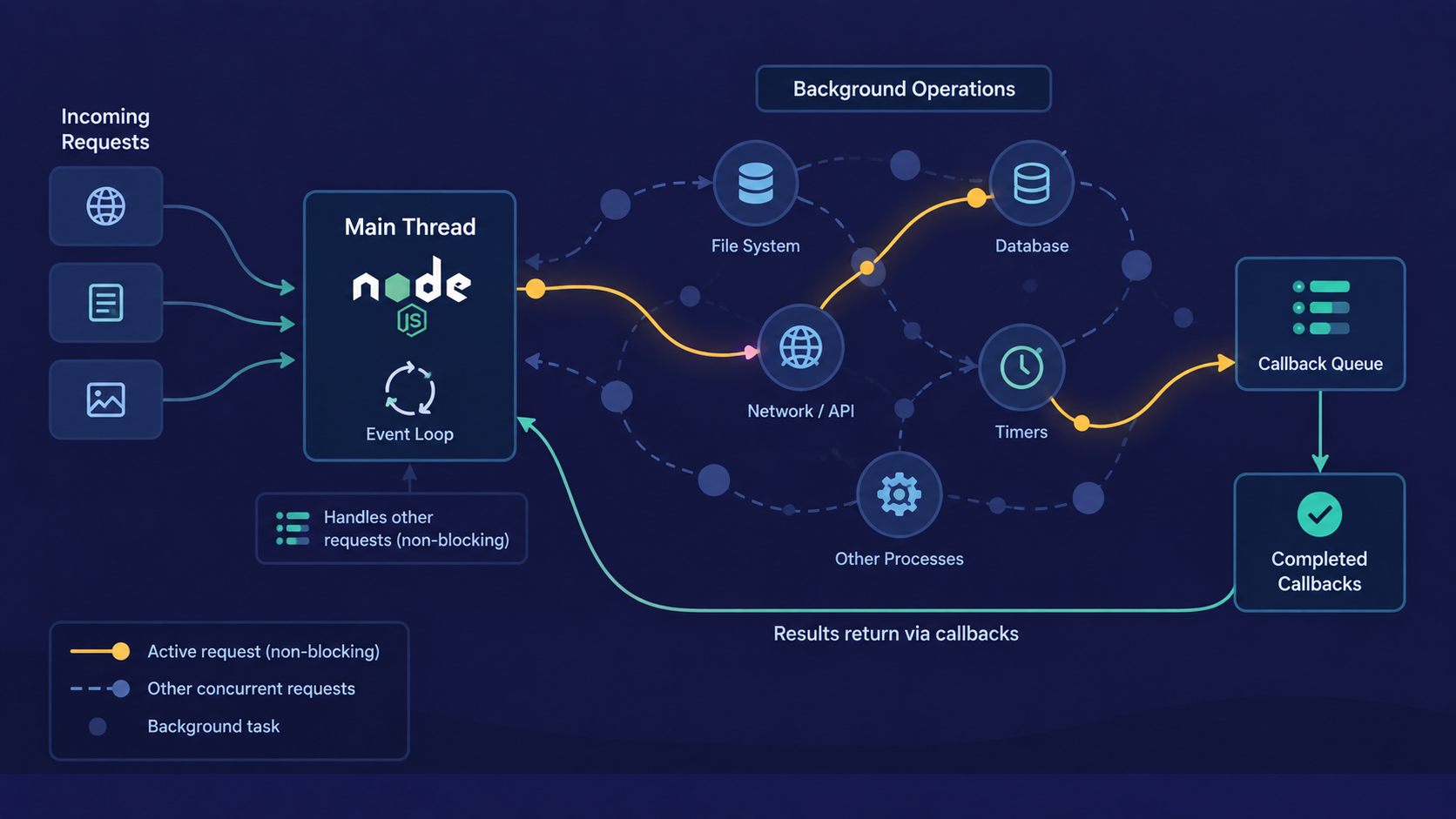
Node.js runs your JavaScript on a single thread, but it never lets that thread sit idle waiting for something slow. Slow work gets handed off in the background, freeing the thread to pick up the next request immediately.
Analogy: The Solo Chef Who Never Waits
Imagine a small restaurant kitchen with exactly one chef.

A customer orders a dish that needs to simmer for ten minutes. A lazy chef would stand at the stove staring at the pot, doing nothing else, for the full ten minutes.
Your chef doesn't do that. They put the pot on the stove, set a timer, and immediately walk to the next table to take another order. When the timer rings, they come back and plate the dish.
One chef. Many orders in progress. Nobody stands in a queue waiting for the chef to be "free" - the chef is always working on something, and slow tasks run quietly in the background.
The Mechanism
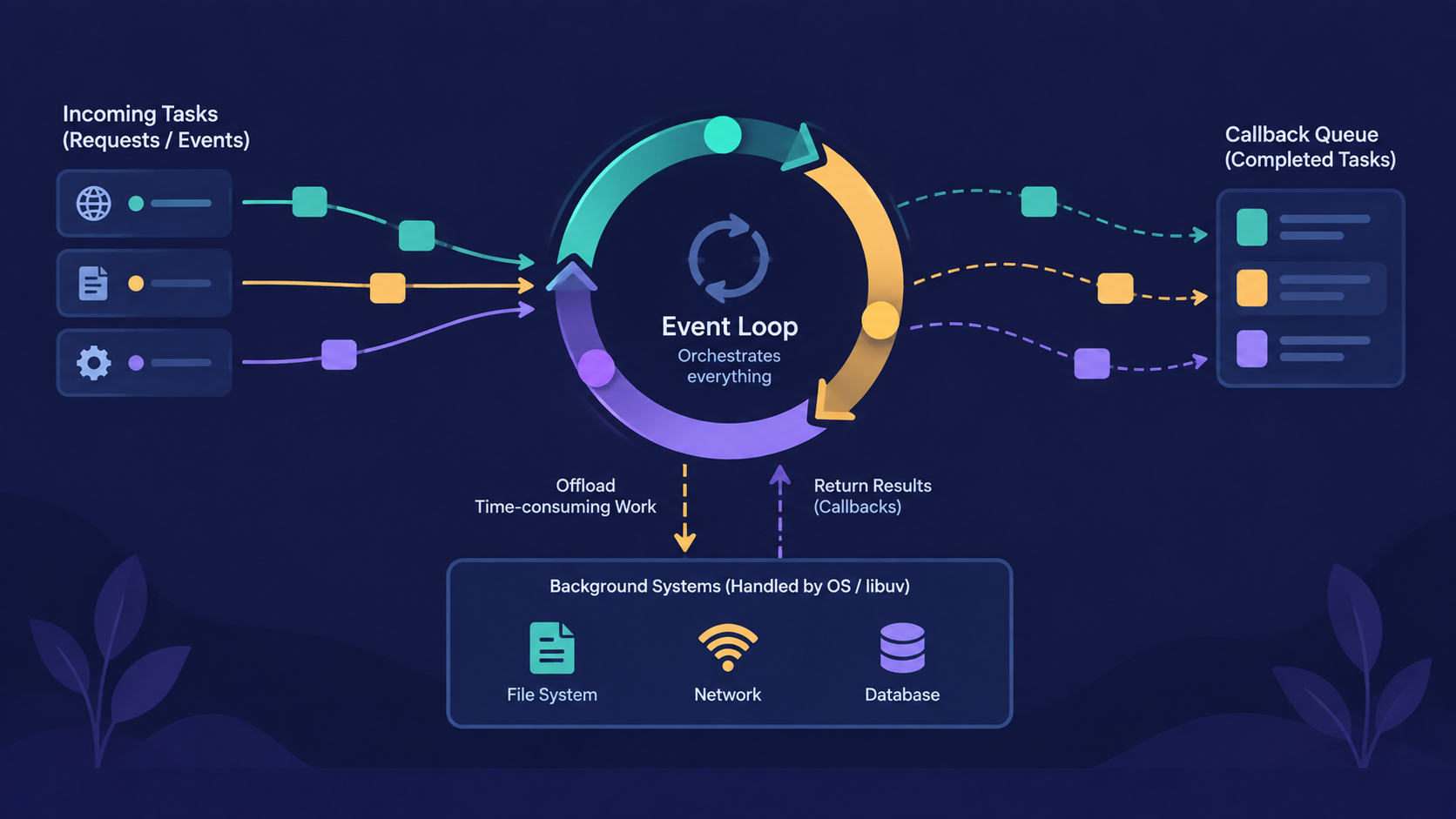
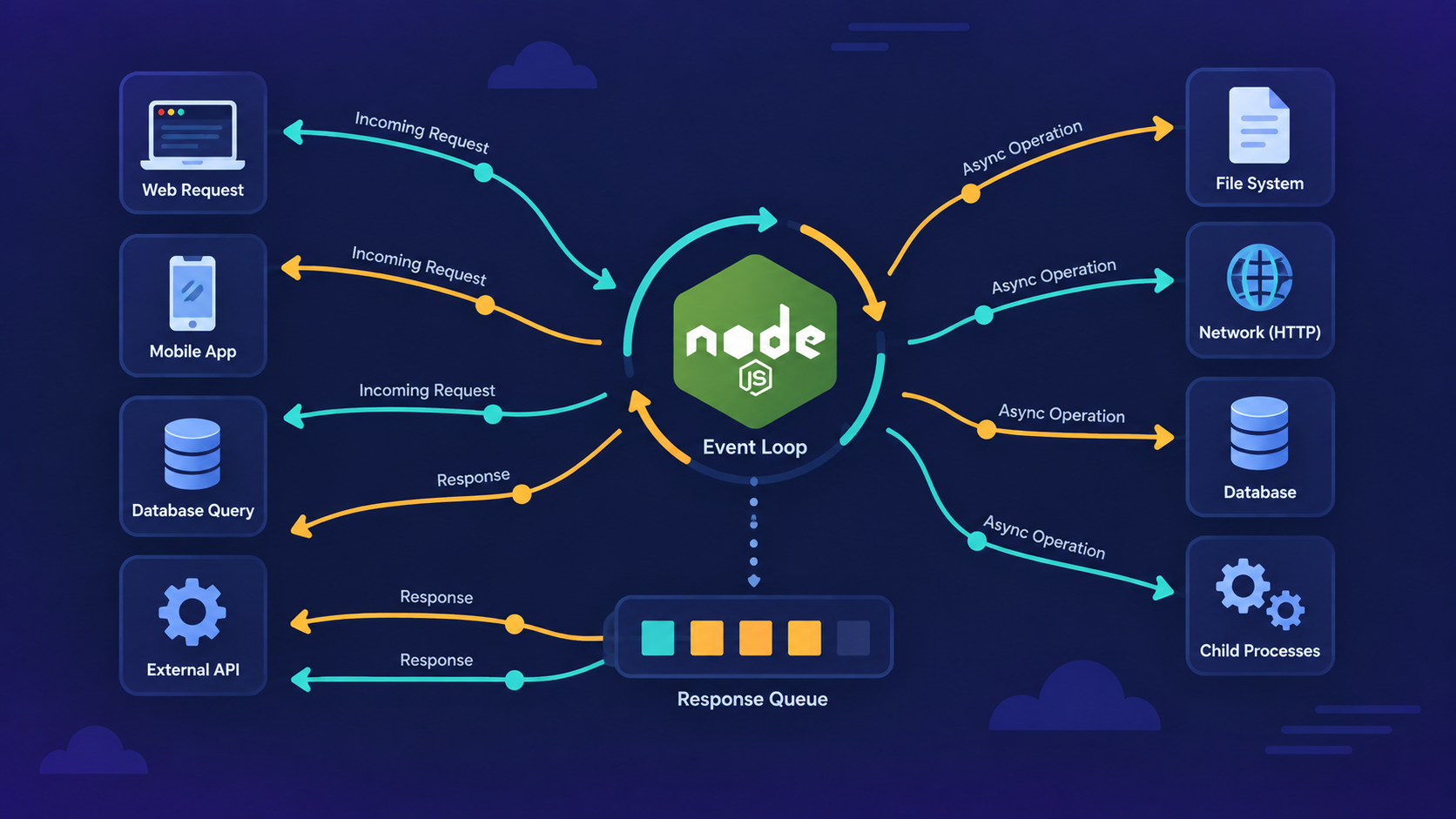
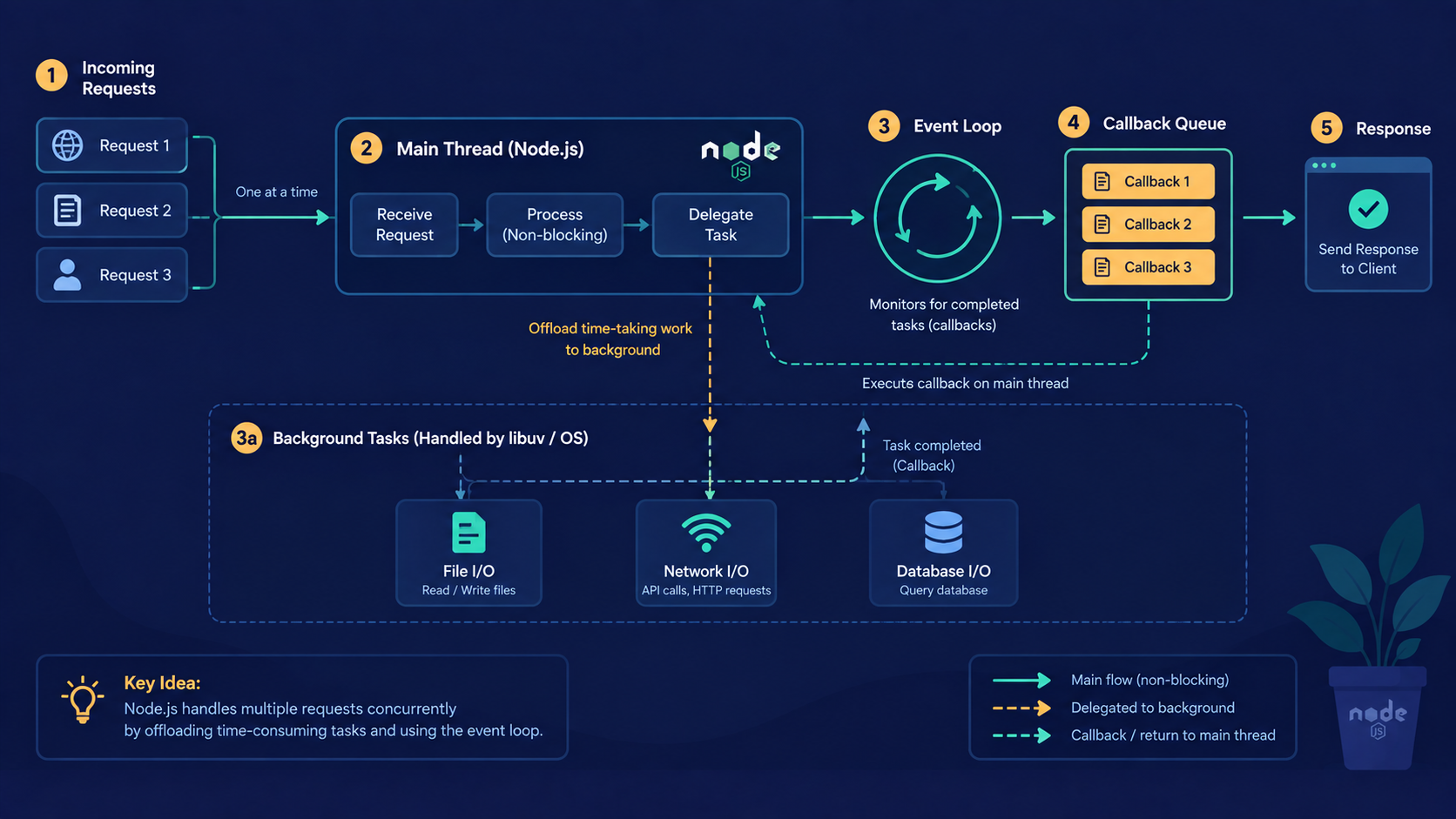
A request arrives. The single thread picks it up and starts running your code.
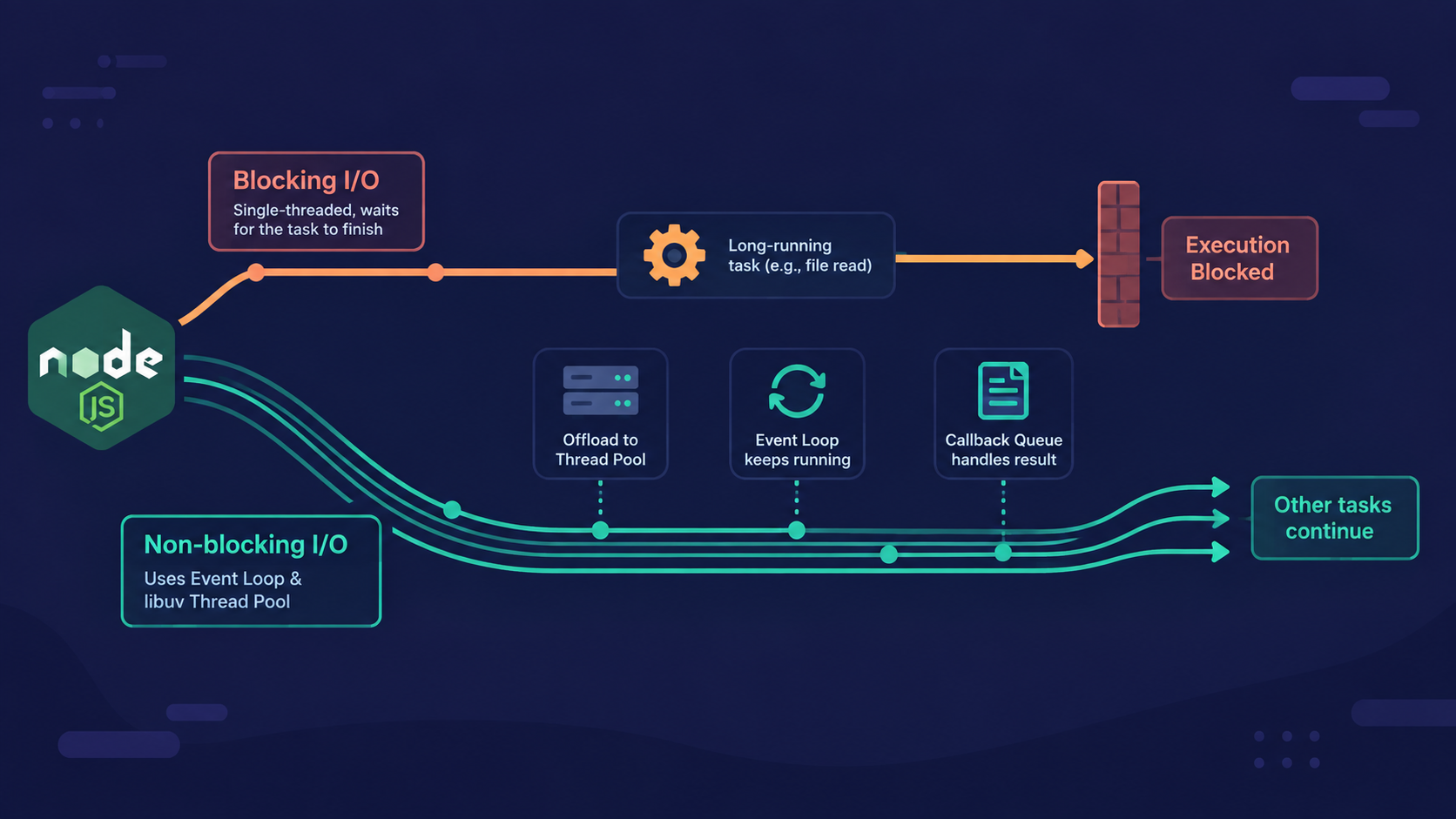
It hits something slow - reading a file, querying a database, calling an API. Instead of waiting, Node.js hands this task off to the system (via libuv, its background engine) and moves on.
The thread is free again. It immediately picks up the next incoming request.
This repeats for every request - start it, delegate the slow part, move to the next one.
When a background task finishes, it doesn't interrupt anything mid-flight. It joins a queue.
The event loop checks that queue continuously, and once the thread is free, it runs the matching callback and sends the response.
Why Do We Need It?
Older servers (like traditional Apache setups) spin up a new thread for every single request. That works, but threads are expensive: each one reserves its own memory. A few thousand simultaneous users can mean a few thousand threads, and the server buckles under its own weight.
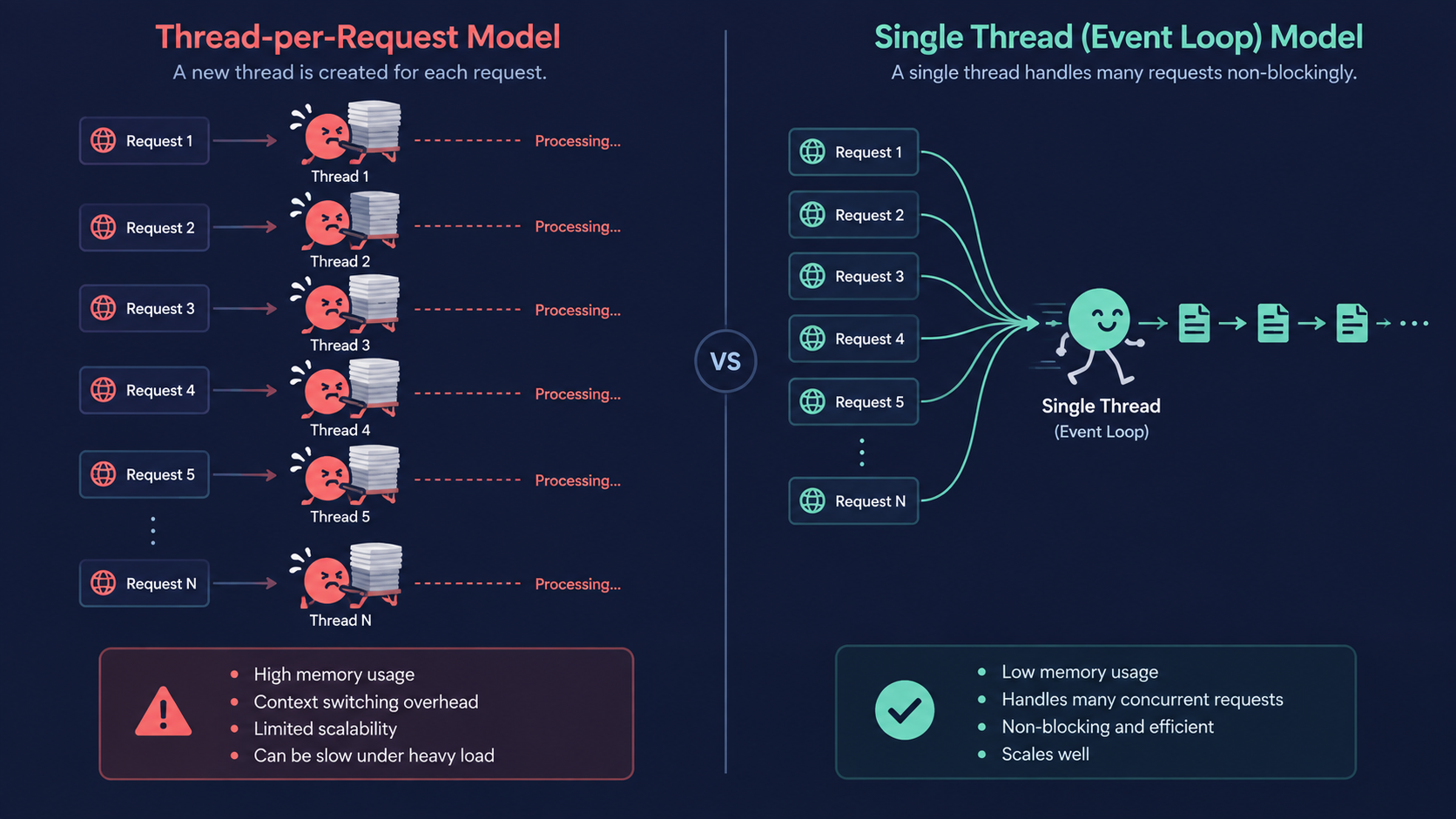
Node.js sidesteps that entirely. One thread, one JavaScript engine, handling an enormous number of requests - because it's never sitting around waiting.
Important Rule: Concurrency Is Not Parallelism
This is where most beginners trip up.
Node.js is concurrent - it juggles many operations by never blocking on any single one. It is not parallel in the same thread - your JavaScript code itself still runs one line at a time.
If you run a heavy, CPU-bound loop (like sorting a huge array synchronously), there's no "waiting" to delegate. That loop blocks the single thread, and every other request freezes until it finishes. The chef can juggle ten simmering pots, but if they sit down to peel a hundred kilos of onions by hand, the whole kitchen stops.
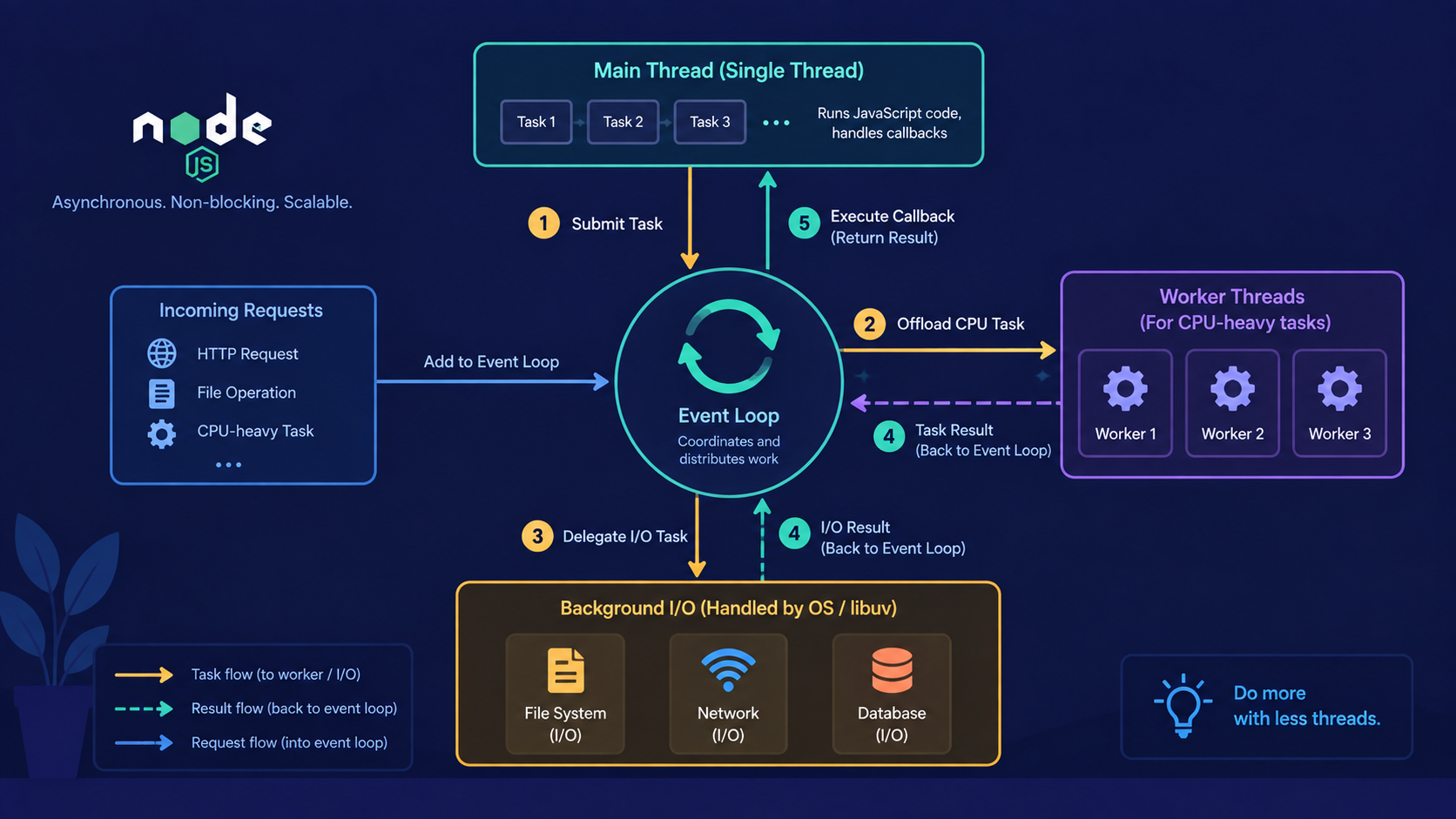
That's exactly why CPU-heavy work gets pushed to worker threads instead - a separate pool of threads reserved for jobs that can't be delegated to the background the normal way.
After knowing how one thread avoids waiting, the next question is: what exactly is checking that queue and deciding what runs next? That's the event loop, and it deserves its own article.
How All of These Work Together
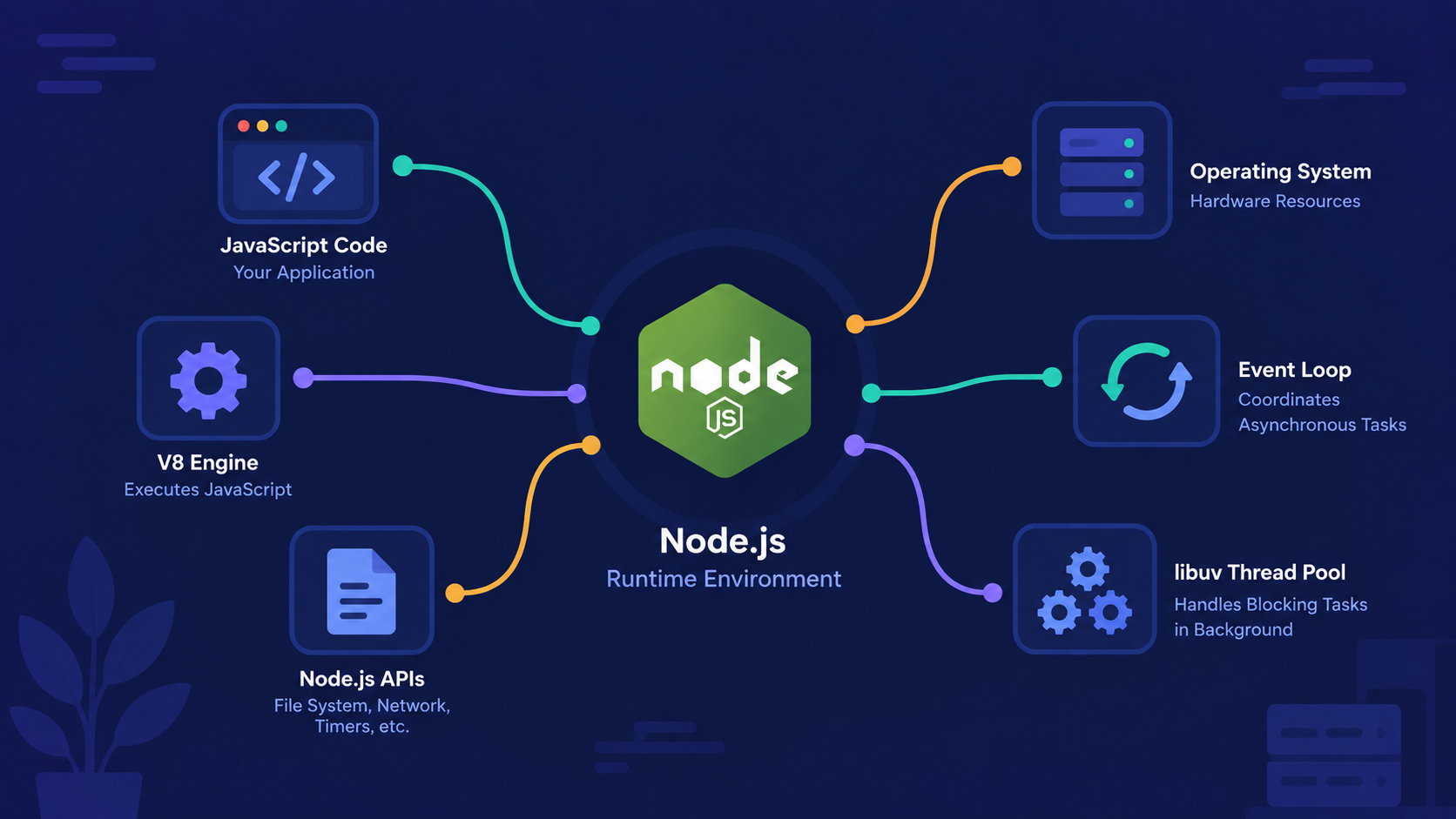
| Piece | Role |
|---|---|
| Main thread | Runs your JavaScript code, one line at a time |
| libuv | Hands off slow I/O (files, network, DB) to the OS in the background |
| Event loop | Watches for finished background tasks and schedules their callbacks |
| Worker threads | A separate pool for genuinely CPU-heavy work, so the main thread stays free |
A thread is a single path of execution inside a program - Node.js main thread is one such path.
A process is the whole running program, which can contain one or many threads. Node.js keeps your code on one thread inside one process, and leans on the operating system's own background workers to do the waiting for it.
Try It Yourself
Hands-on: prove Node.js doesn't block on I/O
Run this and watch the order of the output:
console.log("Order 1 taken");

// setTimeout callback take 2 sec to run and after 2 sec console value print
setTimeout(() => {
  console.log("Order 2 (slow dish) is ready");
}, 2000);

console.log("Order 3 taken");
Expected output:
Order 1 taken
Order 3 taken
Order 2 (slow dish) is ready
Order 3 doesn't wait for Order 2's two-second timer. The thread moved on immediately, and the event loop delivered Order 2's result only once it was ready - exactly like the chef walking to the next table instead of standing at the stove.
We avoid advanced flags and deep libuv internals here - confidence with the core flow comes first.
Conclusion
Node.js runs your code on a single thread, but never blocks that thread on slow work.
The event loop is what checks for finished background tasks and schedules them.
Slow I/O gets delegated to the system in the background, not run on the main thread.
Worker threads exist separately, for CPU-heavy work that can't be delegated.
This is why Node.js handles thousands of requests with a concurrency model, not a thread-per-request one.
If this felt like a lot at once, that's okay. What matters right now is the flow: one thread, never waiting, always delegating.
What's Next?
The next article dives into the piece doing all the scheduling behind the scenes: "The Node.js Event Loop Explained." We'll open up its phases one by one - timers, I/O callbacks, and where setImmediate and process.nextTick actually fit.
If you found this useful, drop a comment or a reaction.